I have so many stories of being places I shouldn’t be because I was just not paying attention.
I’ve ended up in VIP sections (this one, I blame security for because they shoulda been asking themselves what random black women were doing in the VIP section with rock stars, but MY GUESS is that they decided if we were back there, we probably belonged there because WHY ELSE WOULD WE BE THERE? The answer is we were lost!)
I ended up in the Tenderloin and honestly “There but for the Grace of God go I”, because I stepped over people shooting up on the sidewalk and hid between two cars waiting for my rideshare that told me to walk there and wait for a car to pick me up and I am STILL mad about that because the fucking rideshare shoulda known that I was NOT LOCAL since it had all my damn information and honestly WHAT THE FUCK.
Of these two stories, the first one where I wasn’t worried I was gonna get murdered is my favorite.
BUT I have another one to add: the kind where I find a random Black History fact!
For the end of my birth month last year I went to New Orleans. Because I went for a quick day trip when I went on a cruise a few years ago, and I promised myself that I’d come back and spend some real time exploring the city. If you don’t know me, that means walking. I walked ALL over the French Quarter, and the Garden District. Got off the trolley somewhere in between just because I saw a band playing and when I’m on vacation I will absolutely let my curiosity lead.
I also met up with one of my internet pals because of course I did. We went to one of her local watering holes where I definitely drank too much (it was Halloween and still my birth month) and had so many regerts the next day. But the one thing I do NOT regret is going to one of the places that she recommended for breakfast. I went to the Buttermilk Drop Bakery! No this is not an ad, I’m just greedy and I wanna put y’all on.
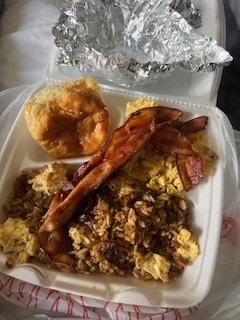
Breakfast rice, bacon and a biscuit so good I’d slap a Georgia white woman. TWICE. [this may be a terrible photo but when I tell you this breffis was fie?!]
Anyway. We’d walked every place that we’d been eating this whole trip, but I didn’t know where this was, and it LOOKED too far to walk. So I decided we could rideshare there and if was close enough, we could just walk back after breakfast. But what had happened was as we were driving farther away from the French Quarter, I realized that we were much farther than I thought we were, and we were not going to be able to walk back because where even WERE we? My sissie: WTH were you doing in the 6th ward?! The answer was being greedy, tbh.
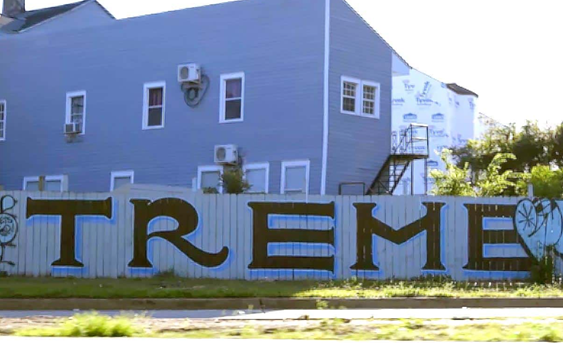
But the other answer was I was standing on Black History guys! Welcome to the first fact of Black History Month about the Oldest African American neighborhood in America. In the 18th and early 19th centuries, free persons of color and eventually enslaved Africans who obtained, bought or bargained for their freedom were able to acquire and own property in Tremé. The ability to acquire, purchase and own real property during an era when America was still immersed in slavery was remarkable and only in New Orleans did this occur with any regularity and consistency.
The Tremé neighborhood began as the Morand Plantation and two forts—St. Ferdinand and St. John. Near the end of the 18th century, Claude Tremé purchased the land from the original plantation owner. By 1794 the Carondelet Canal was built from the French Quarter to Bayou St. John, splitting the land. Developers began building subdivisions throughout the area to house a diverse population that included Caucasians and free persons of color. Tremé abuts the north, or lake, side of the French Quarter, away from the Mississippi River—”back of town” as earlier generations of New Orleanians used to say. Its traditional borders were Rampart Street on the south, Canal Street on the west, Esplanade Avenue on the east, and Broad Street on the north. Claiborne Avenue is a primary thoroughfare through the neighborhood. At the end of the 19th century, the Storyville red-light district was carved out of the upper part of Tremé; in the 1940s this was torn down and made into a public housing project. This area is no longer considered part of the neighborhood. The “town square” of Tremé was Congo Square—originally known as “Place des Nègres”—where the enslaved gathered on Sundays to dance. This tradition flourished until the United States took control, and officials grew more anxious about unsupervised gatherings of slaves in the years before the Civil War. [Hey did you know that there was a Jim Crow law that stated it was illegal for Black people to gather in groups of more than 5? That law no longer exists, but lemme just say that when you’re black, you’re never really lonely, because there will always be a white person. all up in your business. ]
The square was also an important place of business for slaves, enabling some to purchase their freedom from selling crafts and goods there. For much of the rest of the 19th century, the square was an open-air market. “Creoles of color” brass and symphonic bands gave concerts, providing the foundation for a more improvisational style that would come to be known as “Jazz”. At the end of the 19th century, the city officially renamed the square “Beauregard Square” after the French Créole Confederate General P.G.T. Beauregard, but the neighborhood people seldom used that name. Late in the 20th century, the city restored the traditional name of “Congo Square”.
In the early 1960s, in an urban renewal project later considered a mistake (that probably happened on purpose) by most analysts, a large portion of central Tremé was torn down. The land stood vacant for some time, then in the 1970s the city created Louis Armstrong Park in the area and named Congo Square within Armstrong Park. In 1994, the New Orleans Jazz National Historical Park was established here.
The neighborhood is viewed by many as ground zero for New Orleans culture. It’s the site of many major events that have shaped the course of Black America in the past two centuries. Filled with incredible history in terms of culture, music, and more, Tremé is arguably the most significant neighborhood in the whole city.
:::closes up all the websites I popped open to give y’all this information:::
Also. The buttermilk bakery is not a sit down restaurant and I didn’t know that until I got there, so I had to once again stand awkwardly on a corner while I waited for my rideshare to come pick me and my friend up and this is really why people don’t like to let me roam around the country without supervision. Yes, I know I said I was with a friend but that changes nothing because she also just stood there when I opened the door for a grown ass man, and said “get on in here, princess” so I’m not sure she counts as supervision.
ANYWAY.
Happy Monday! Happy February! Happy Black History Month! Please know that I’m keeping this month aggressively Black because every time somebody shares a Black History fact, a Black girl’s edges lay a little smoother.


 Yeah I said it