I actually did not have plans to watch the Grammys.
Because GET OFF MY LAWN *shakes fist*
BUT THEN I FOUND OUT THAT THE CAST OF HAMILTON WAS GONNA PERFORM
(Hi! I’m Briya and I loooooooove musicals!)
(I love music in general)
(something something stereotypes about black people and music)
(and watermelon. Which I also love)

I ESPECIALLY LOVE ME A GOOD ROCK SONG.
Like, LOVE.
Which, growing up, I got a lot of flack for.
I’m not sure why though.
::whispers:: Yes, I am. Because people who don’t know the history of rock and roll think it’s not music for black people.
But that’s not so!
The phrase “rocking and rolling” was originally used to describe the spiritual fervor of black church rituals and as a sexual analogy as early as the 1920’s.
In fact, the word “rock” has long been used in gospel songs (Rock My Soul, Rock Me, Rock Daniel and so on).
I could make a comment here, but I’m not going to. I’m just going to give you a few minutes to re-read the list of gospel songs. OR ARE THEY?
IN FACT, Sister Rosetta Tharpe (born in 1915) became gospel music’s first crossover artist and its first great recording star, referred to later as “the original soul sister” and “the godmother of rock and roll”. Tharpe recorded for the first time – four sides with Decca Records backed by Lucky Millinder’s jazz orchestra. The first gospel songs ever recorded by Decca, “Rock Me,” “That’s All,” “My Man and I” and “The Lonesome Road” became instant hits, establishing Tharpe as an overnight sensation and one of the first commercially successful gospel recording artists. Her records caused an immediate furor: many churchgoers were shocked by the mixture of gospel-based lyrics and secular-sounding music, but secular audiences loved them.

Tharpe’s appearances with jazz artist Cab Calloway at Harlem’s Cotton Club and in John Hammond’s “Spirituals to Swing” concert at Carnegie Hall, gained her even more fame, along with notoriety. These performances, which both shocked and awed the crowds, were controversial as well as revolutionary in several respects. Performing gospel music in front of secular, ‘nightclub’ audiences and alongside blues, jazz musicians and dancers was highly unusual, and within conservative religious circles the mere fact of a woman performing guitar music, particularly in those settings, was frowned upon. For these reasons, Tharpe was often falling out of favour with segments within the gospel community.
(Guess who had a guitar and didn’t give a fu…damn? This fine upstanding gospel singer. That’s who)

Other late 1930s hits, which combined gospel themes with bouncy up-tempo arrangements, continued to become hits among audiences with little previous exposure to gospel music. Tharpe continued recording during World War II. Her song “Strange Things Happening Every Day”, was the first gospel song to make Billboard’s Harlem Hit Parade (later known as Race Records, then R&B) Top Ten. This record made in 1944 has been credited by some as being the “First rock and roll record”. Tharpe’s performances were curtailed by a stroke in 1970, but she is cited as an early influence on figures such as Little Richard, Johnny Cash, Chuck Berry, Elvis Presley and Jerry Lee Lewis.

And I’m also gonna guess she made an impression on this pretty fucking talented lady

Brittany Howard. Lead Singer of the Alabama Shakes.
Winner of Best Rock Song
SECOND Black woman to ever win in this category.

And it’s probably because of Sister Tharpe that she can.

I bet she played the HELL outta that guitar. See what I did there? Anybody? No?


*RACE RECORDS. Then R&B
**Really, guys? Is it really us that keeps “playing the race card”?
Anyways. That’s all.
See y’all tomorrow.

Y’all. I’m tired.
I took baby sissie (/Sister in Law) to see Lianne La Havas at Largo at the Coronet last night.
I mentioned it yesterday, but lemme tell you:
I found her by accident because Pandora did it again
but this time I was all


And then I was like WHO IS THIS BECAUSE HER VOICE IS AMAZING?!
A few months later, The Fonda e-mailed me like, Yeah, hey, so she’s gonna be here tomorrow.
I was like, “No shit?! I’m gonna buy me some tickets and go”

So I did.

And because this is the 21st century, I also instagrammed it.

fonda

And baby sis was like WHY DID I NOT KNOW YOU WERE DOING THIS?
Answer: Because I’m impulsive and didn’t know I was gonna go ‘til I went
Also true: I had no idea that anybody even knew who she was.
ANOTHER TRUTH: My brother married a combination of his sisters, so I totally SHOULDA known that she’d either heard of her or would like her.

ANYWAYS.
I try to buy gifts that I know people will like, since I’m not especially a fan of gift cards unless you’re a pre-teen because they are quite possibly
the hardest people in the entire world to shop for because they liked it yesterday but today they don’t because they’re not babies, they’re 12 FFS and I couldn’t possibly know about anything cool.
(“For Freaks Sake” because I would pop a 12 year old dead in the mouth for saying FUCK)
(Yeah, I said it. And I totally mean it. Ask any one of my nieces. Or nephews. Or even/especially? my kids.)
(also #GETOFFMYLAWN)

So when I was frantically buying Christmas gifts because of COURSE I wait to the last minute to do my shopping, I got ANOTHER e-mail.
This time from Largo at The Coronet. “Hey, so Lianne La Havas is BACK in town next year and you should maybe come see her”
And I was like, FUCK YEAH ( ‘Cause I’m grown)
I SHOULD. IN FACT, I SHOULD TAKE MY SISTER IN LAW.
[I don’t know about you, but I am of the “one gift for you, one gift for me” kind of shopper]

We had a GREAT time.
I’d post video only the Largo has a no phone/camera policy*
Which is awesome because I didn’t have to worry about some asshole who never put his phone down and also didn’t care if he was blocking my view.
But not awesome because she sang this and it was amazing and if I coulda gotten some footage of that I woulda but instead here’s today fact:
In 1987, Aretha Franklin became the first woman to be inducted into the Rock and Roll Hall of Fame.

Sometimes your facts are short and to the point.
Today is one of those days.
[My stories are always long and rambly. So sorry I’m not sorry]

But I would be remiss if I didn’t leave you with some of the Queen of Soul’s music,
So. Did you know that she once pinch hit for Luciano Pavarotti?
Also please to enjoy one of my favorite songs [She was one hot mama!]

That’s all folks! I’m off to enjoy my weekend which for a change will include Monday.
So don’t be looking for a fact. It won’t be there.

*I have a policy, too. I DO WHAT I WANT.
baby sis
[taken in the venue immediately after he said don’t do that]

And you.
I will always love you too.
And that’s why I share these BHFOTD with y’all.
Or at least part of the reason.

So did you know that aside from BHFOTDs I occasionally do deathiversaries?
I don’t really think that’s a word, but it is now. Because I’m using it.
[that will never apply to irregardless. That will never be a word]
Usually, deathiversaries are because people ask for them,
but this one is because I was listening to Pandora and I don’t know if it’s just me
but they are always dropping random songs into my perfectly curated stations and
PLEASE FFS STOP IT. I DID NOT CREATE A NICKI MINAJ STATION FOR IT TO RANDOMLY THROW IN SOME WHITNEY HOUSTON SONG.

And EVERY TIME I hear Whitney Houston song, I think about that time that my cousin’s grandma drove all of us (plus sissie) to Laughlin and she had exactly ONE tape in her car and that album was WHITNEY HOUSTON and once we left civilization (/Riverside county/ outside of regular radio stations because really Riverside county IS NOT CIVILIZED)  we didn’t have any radio stations to listen to and so we listened to THAT ONE TAPE and I don’t know if you know this but it is around 6 hours to drive from Compton to Laughlin, Nevada and by that time I was SAVING ALL MY LOVE FOR YOU’d OUT. OUT, ya hear me?

That’s right kids! Today is the deathiversary of Whitney Houston. (2012)
Whitney Elizabeth Houston (born August 9, 1963) was an African American singer, actress, and producer.
Houston’s crossover appeal on the popular music charts, as well as her prominence on MTV, influenced several African American (and probably just OTHER) women artists to follow in her footsteps
And because I’ve got stuff to do and places to go (tonight I’m goin’ to see Lianne La Havas! Another black singer– a Brit! – who probably was influenced by Ms Whitney) it’s gonna be a lightning round!

DID YOU KNOW…She released seven studio albums and three movie soundtrack albums, all of which have diamond, multi-platinum, platinum or gold certification? AND:
1. Houston is the only (black/white/or any other color) artist to chart seven consecutive No. 1 Billboard Hot 100 hits.
2. She is the only (black/white/or any other color) woman to have two number-one Billboard 200Album awards (formerly “Top Pop Albums”) on the Billboard magazine year-end charts.
3. Houston’s 1985 debut album Whitney Houston became the best-selling debut album by a (black/white/or any other color) woman in history. Rolling Stone named it the best album of 1986.
4. Her second studio album Whitney (1987) became the first album by a (black/white/or any other color) woman to debut at number one on the Billboard200 albums chart.
5. Houston’s first acting role was as the star of the feature film The Bodyguard (1992). The film’s original soundtrack won the 1994 Grammy Award for Album of the Year
a. Her lead single from the movie The Bodyguard, “I Will Always Love You”, became the best-selling single by a (black/white or any other color) woman in music history.
b. With the album, Houston became the FIRST act (solo or group, male or female, black/white/or any other color) to sell more than a million copies of an album within a single week period under Nielsen SoundScan system
6. At the age of 15, she sang background vocals on Chaka Khan’s hit single “I’m Every Woman” (See what I did there?)
7. She started out as a fashion model in the early 1980s, and became ONE of the first African American women to cover Seventeen magazine

Look at that! Whitney at 17 on the cover of seventeen!

And that’s today’s lightning round of facts and firsts about Ms. Whitney Elizabeth Houston Brown.
Hope you enjoyed that walk down memory lane. And if you didn’t, I guess you can try again tomorrow.
When I send you another fact. Because sharing is caring guys. And I love you.
[I’m not sorry. I also can never resist]

I’ve lived in a bunch of places. A BUNCH.
And because of that I’ve also worked in a bunch of places. A bajillion.
Or at least it feels that way.
I even worked for my current employer’s doppelganger (can non-people have doppelgangers?) in Boston. .
Beth Israel Deaconess Hospital.
Non clinical staff, of course.

It’s just like my current big fancy hospital.
With less famous people.
To be fair though, I didn’t work on campus.
In fact, the only famous people I even met in Boston were Celtics
(I lived down the street from where the Celtics used to practice)
(and by met I mean, I saw them from afar. Because NO)
And famous political folks.
I mean, IT’S BOSTON.

So why wouldn’t I have a completely ridiculous story to tell you about President Franklin Delano Roosevelt’s grandson?

I used to work at this place and this attorney named James used to come in and get subway passes.
I’m assuming they were for his kids or something because DOES THE PRESIDENT’S GRANDSON TAKE THE T?
I dunno. I never asked, I just handed them out when they showed up.
So one day he shows up and he has something on his forehead
Me: Hey you got a little shmutz on your forehead.
Him: …what?
Me: :::reaches up to wipe it off:::
Me: :::pauses mid reach:::
Me: :::thinks about what DAY it is:::
Me: UM. Nevermind
Me: [DID I REALLY JUST FORGET IT’S ASH WEDNESDAY?!?!?!}
Me: See you next month! [internal screaming continues]

I also kinda looked around because I was a little concerned that I was gonna get struck by lightning where I stood. But I didn’t. Hallelujah!

Yeah. I’m no saint. Unlike Servant of God (did you know that was an actual title?) Augustus Tolton.
He was the first Roman Catholic priest in the United States publicly known to be black when he was ordained in 1886*.
A former slave who was baptized and reared Catholic, Tolton studied formally in Rome.

He was ordained on Easter Sunday of 1886 at the Archbasilica of St. John Lateran. Assigned to the diocese of Alton (now the Diocese of Springfield).
Tolton celebrated his first public Mass at St. Boniface church in Quincy. He attempted to organize a parish there, but over the years met with resistance from both white Catholics (many of whom were racists ethnic German) and Protestant blacks, who did not want him trying to attract people to another denomination
After being reassigned to Chicago, Tolton led a mission society, St. Augustine’s, that met in the basement of St. Mary’s Church.
He led the development and administration of the Negro “national parish” of St. Monica’s Catholic Church, built at 36th and Dearborn Streets on the South Side, Chicago.
The church grew to have 600 parishioners. Tolton’s success at ministering to black Catholics quickly earned him national attention within the Catholic hierarchy.
“Good Father Gus”, as he was called by many, was known for his “eloquent sermons, his beautiful singing voice and his talent for playing the accordion.”

At the age of 43, he collapsed and died as a result of a heat wave in Chicago in 1897. Tolton was buried in Quincy in the priests’ lot in St. Peter’s Cemetery, which had been his expressed wish.
After Tolton’s death, St. Monica’s was made a mission of St. Elizabeth’s Church. In 1924 it was closed as a national parish.

On 2 March 2010 Cardinal George of Chicago announced that he was beginning an official investigation into Tolton’s life and virtues with a view to opening the Cause for his canonization. This Cause for sainthood is also being advanced by the Diocese of Springfield, Illinois, where Tolton first served as priest, as well as the Diocese of Jefferson City, Missouri, where his family was enslaved.
And on September 29, 2014, at Saint James Chapel at the Archbishop Quigley Center in Chicago, Illinois, Cardinal George formally closed the investigation into the life and virtues of Father Augustus Tolton. The dossier of research into Tolton’s life moves to the Vatican where the documents collected which support his cause will be analyzed, bound into a book called a “positio,” or official position paper, and evaluated by theologians, and then, supporters hope, passed on to the pope, who can declare Tolton “venerable” if the pope determines he led a life of heroic virtue.

Maybe in another few years, if I ever repeat a fact, I can talk about SAINT Augustus Tolton. Although quite honestly any person born a slave who managed not to kill his “owners”, or overseers, or anybody else who stood in the way of being free is already a saint.
But that’s just me.
*James Augustine Healy, ordained in 1854, and Patrick Francis Healy, ordained in 1864 were of mixed-race, which probably means they was white passing

Nesto likes to tell me horrifying stories of how he almost died. Then he’ll be all: Oh, I never told you that?
Like, nah. I would definitely remember a story where you almost died.
To date there have been three. In case you were wondering.
[And these are just the deployment stories. Not the “growing up as a black boy/teen/man in Los Angeles” stories]
[shudders]
I feel like you don’t FORGET stories where you almost died.
Or at least I don’t. I save them for BHFOTD!
Let’s get to it, shall we?

I hate pjs.

This is only important because Nesto is always complaining about wearing clothes around the house because what if somebody comes by and really honey, I DON’T CARE THEY SHOULD CALL FIRST because I’m empty nesting and apparently this means that I’m always throwing a no pants party at my house and none of you are invited so please call before you drop in or I’ll never hear the end of it.

BUT.

I love bacon. So if I’m gonna fry me up some bacon, I put on a robe* ‘cause bacon grease hurts like a mofo.
And I have never NOT regretted it when I got all cocky and decided I didn’t need protection.
[I feel like maybe there’s a joke there somewhere]
ANYWAYS. SO I’M WEARING MY RATTY OLD ROBE. And making bacon.
And I reach over the stove to grab something, and a tiny little string catches fire.
And because it’s early (and it is, I’m up before everyone in my house always), I’m not thinking.
And because I’m not thinking I just kinda shake my arm to put the fire out.
AND THEN MY WHOLE SLEEVE IS ON FIRE.
AND NOW I’M PANICKING AND SCREAMING AND RUNNING AROUND IN CIRCLES.
No. I did not stop drop and roll.
But I did finally have enough sense to take off my robe of death and stomp out the flames with my bunny slippers.
What does this have to do with the BHFOTD?
I’m glad you asked!
So last week I went on a field trip with Lexie.
To Olvera Street. For taquitos! And Margaritas!
And also for “Forgotten Founders: The Hidden African Ancestry of Los Angeles” Exhibit & Opening Reception
(My friends are fancy, guys. She gets invites to stuff)
My guess is that they weren’t so much FORGOTTEN as they were LET’S PRETEND THAT THIS WHOLE COUNTRY WASN’T BUILT ON THE BACKS OF BLACK PEOPLE, but whatever.
It was interesting (and free, Los Angeles people!)

One of the “forgotten” people in this exhibit was Sam Haskins.
Call Fireman Sam Haskins is the earliest known black man to work on the Los Angeles Fire Department. Born a slave in Virginia, Haskins came to Los Angeles sometime in 1880.
In 1892 Haskins worked as a “Call Fireman”, a paid position that was part time, filling in for members off sick or on vacation. Most call firemen eventually filled a permanent position when one became available.
Not only was Sam the first black firefighter, he was the first firefighter in the history of the city to die in the line of duty.

Strangely enough though, it wasn’t until 2002 that he was acknowledged/discovered as the first black member of the department
Fire Department documents have long recorded George Washington Bright as the first black member of the department. Bright was appointed as a volunteer in 1897 and, a month later, promoted to a full-time firefighter.
A crime analyst stumbled across Haskins while doing genealogy research for someone else who died in that same year. Up to that point, Haskins’ existence had been unknown
But the evidence found includes 1895 newspaper stories about Haskins’ death, but no photograph.

A ceremony was scheduled to commemorate Haskins’ death, and a headstone was placed on his grave at Evergreen Cemetery in Boyle Heights, where he was buried in 1895.
That marker didn’t just give a long-dead firefighter his due; it rewrote the history of the LAFD.

Anyways.
That’s today’s story folks. If you’re in the area, I highly recommend the exhibit. It’s small and kid friendly. It even has pages for coloring!
And when you’re done, stroll around Olvera Street. That’s ALWAYS fun! I’ve been going since I was a kid.
Only learn from my parent’s mistakes: those feather roach clips are NOT for your hair.

THE MORE YOU KNOW.


Well. I mean. Not technically*.
I mean I’ve talked about him here…

thriller
[Thriller/Well Vodka. Don’t do it]

And I talked about him THERE (but really this was about Quincy Delight Jones. Jr. and The Grammys)
(Delight!)
BUT. Not an ACTUALY BHFOTD.
And. Usually I take the day after Super Bowl Sunday to talk about Football.
But since I hate the Broncos, the Steelers didn’t play AND the Panthers didn’t win, let’s talk about other stuff.

Like Michael Jackson. Which IS talking about the Super Bowl I guess, because guess who was the first artist (black/white or any other color) to perform SOLO at the Super Bowl?

Michael Joseph Jackson.

Michael Jackson performed Jam, Billie Jean, Black or White, We are the World, and Heal the World at Super Bowl 27 at The Rose Bowl in Los Angeles, CA.
It has been claimed to be one of the most watched events in American television history. After 1993, there was a deliberate effort to attract top performers for the halftime shows.

Did you guys know that Los Angeles has hosted the Super Bowl a total of 7 times? The only two cities that have hosted more times are tied at 10 times (Miami/New Orleans)
And I am not mad at all. Because really, Miami? New Orleans? I would like to go to both of those places even though I feel like no good could come from me being there.

But!
California is HUGE. So if we combined ALL (San Diego/NorCal) of the California Super Bowls we win at 11! It doesn’t work that way, but I’M JUST SAYING. LA hasn’t been able to host because you need a team in order to have a Super Bowl.
(Hellooooo, Los Angeles Rams!)

I guess until then I can comfort myself with the fact that this last Super Bowl was played in the Bay Areaaaaaa. (Y’all know I’m not sorry for that)
Where the Caroline Panthers were in the home of the Black Panthers, The Party that is. I’m pretty sure there’s no relation.
(Aside from the fact that SOME people didn’t like blackness of either of these panthers. No? Nobody..? FINE)

The Black Panther Party’s core practice was its armed citizens’ patrols to monitor the behavior of police officers and challenge police brutality in Oakland, California.
In 1969, community social programs became a core activity of party members. The Black Panther Party instituted a variety of community social programs, most extensively the Free Breakfast for Children Programs, and community health clinics.
Scholars have characterized the Black Panther Party as the most influential black movement organization of the late 1960s, and “the strongest link between the domestic Black Liberation Struggle and global opponents of American imperialism.”
Other commentators have described the Party as more criminal than political, characterized by “defiant posturing over substance”.
Which I suppose is how “other commentators” have described Cam Newton.

Hmmmm….I wonder who those “other commentators” are? [Hint: No, I don’t. I know exactly who they are]

There is considerable debate about the impact that the Black Panther Party had on the greater society. Author Jama Lazerow writes:

As inheritors of the discipline, pride, and calm self-assurance preached by Malcolm X, the Panthers became national heroes in black communities by infusing abstract nationalism with street toughness—by joining the rhythms of black working-class youth culture to the interracial élan and effervescence of Bay Area New Left politics … In 1966, the Panthers defined Oakland’s ghetto as a territory, the police as interlopers, and the Panther mission as the defense of community. The Panthers’ famous “policing the police” drew attention to the spatial remove that White Americans enjoyed from the police brutality that had come to characterize life in black urban communities

In my opinion, such as it is, there is no debate. Without Black Panthers leading the way, would there be a Black Lives Matter?

ANYWAYS. Hope you enjoyed today’s super random BHFOTD.

IF YOU ARE WONDERING HOW IN THE ACTUAL FUCK DOES ANY OF THIS HAVE TO DO WITH SUPER BOWL 50, THEN I GUESS YOU WEREN’T PAYING ATTENTION. ….AT ALL.
*guess I didn’t really talk about him THIS time either.


Hi Guys!

Most of you know that in previous years, I bullied my sister into writing some of these BHFOTDs with me.
Because I’m lazy.
But this year my sissie got a BIG! FANCY! PROMOTION!
So she’s busier than a one legged man in an ass kicking contest. Or so she says.
I thought supervisors just sat around telling other people what to do?
No? Fine.
This year I’m gonna give her a pass, but I’m gonna “respectfully” suggest that she figure out a way to get it together for next year.

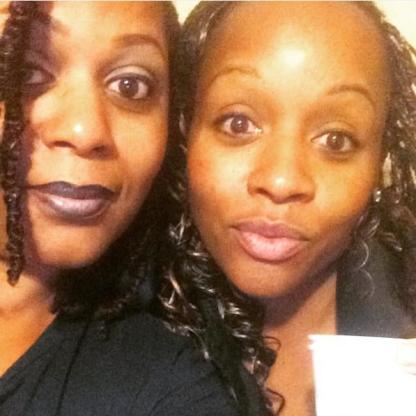
THIS IS MY SISSIE NEW PEOPLE.

seesters
[She cute]

If you see her in the street, leave her alone! Because she knows ju jitsu and will probably kick your ass, Stranger Danger.
Or say hi and ask for a BHFOTD. Choose your own adventure and all that.

MOVING ON.
I was ALLLL set to write about something else entirely when my sissie’s birthday twin passed away yesterday.
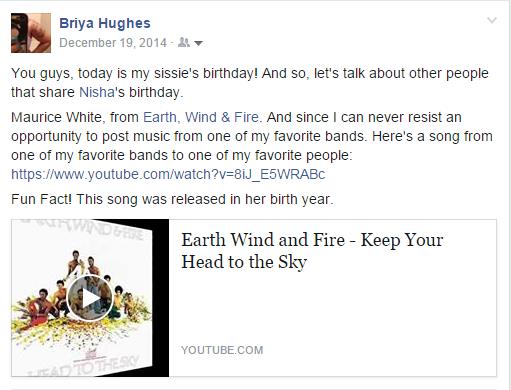
Did you guys know that Nisha shared a birthday with Maurice White, lead singer of Earth Wind & Fire?

nisha bday
You can see what a joy it is to be related to me.

ANYWAYS.
Back to Maurice. He was the founder of the band Earth, Wind & Fire. He was also the older brother of current Earth, Wind & Fire member Verdine (VERDINE!) White, and former member Fred White.
With Maurice as the bandleader and producer of most of the band’s albums, EWF earned legendary status winning six Grammy Awards out of 14 nominations, an NAACP Hall of Fame Award, a star on the Hollywood Boulevard Walk of Fame and four American Music Awards and the sale of over 90 million of the group’s albums worldwide.

As a member of the band, Maurice was bestowed with such honors of being inducted into the Rock and Roll Hall of Fame, the Vocal Group Hall of Fame, The Songwriters Hall of Fame and The NAACP Image Awards Hall of Fame.

Maurice White and EWF will also go down in Black history as the first African American band to sell out Madison Square Garden.

White has been called “an innovator” and “someone who has had a profound impact upon the music industry as a whole” by Chaka Khan, and has been cited as a main influence by artists such as Bilal and Lenny Kravitz (NSFW. NOT SORRY).

Lest you think this is some doom & gloom obituary type fact of the day, I have a fun fact!
Nisha & Maurice were not only birthday twins.
Nisha was only a few degrees of separation from Maurice White.

Maurice White composed As One which was performed by Memphis Bleek (Jay-Z’s The Blueprint2: The Gift & The Curse)
Memphis Bleek recorded Hood to Hood with Ras Kass.
Ras Kass used to date … YOU GUESSED IT! My Sissie!
That’s all for this week folks. I get weekends off!
Stay tuned next week for “What does Briya have to say about Black People?”

Mostly because when I go out alcohol is involved.
Then my phone gets drunk and I’m looking back at my pictures
like… WHAT IS GOING ON HERE?

blurry
[I’m sure it’s only a coincidence* that Monica is in both of these pictures when my phone is drunk]

And then I remember: Whiskey. My phone enjoys whiskey.
Also. My subjects are uncooperative. Ahem.

megan
[Hi, Megan!]

Luckily I have a day job.
[No you guys, this isn’t my day job either. Even though y’all be acting like it, this is just an entertaining side gig]

But THIS GUY.
Gordon Parks
[guessing prolly not a selfie]

This gentleman is Gordon Parks.
Gordon Parks purchased his first camera at the age of 25 after viewing photographs of migrant workers in a magazine.
His early fashion photographs caught the attention of Marva Louis, wife of the boxer Joe Louis, who encouraged Parks to move to a larger city. Parks and his wife relocated to Chicago in 1940.
He became interested in the low-income black neighborhoods of Chicago’s South Side. In 1941, Parks won a photography fellowship with the Farm Security Administration for his images of the inner city. Parks created some of his most enduring photographs during this fellowship, including “American Gothic, Washington, D.C.,” picturing a member of the FSA cleaning crew in front of an American flag.

After the FSA disbanded, Parks continued to take photographs for the Office of War Information and the Standard Oil Photography Project. He also became a freelance photographer for Vogue
Relocating to Harlem, Parks continued to document city images and characters while working in the fashion industry. His 1948 photographic essay on a Harlem gang leader won Parks a position as a staff photographer for LIFE magazine, the nation’s highest-circulation photographic publication.

He became the first African-American photographer for both Life and Vogue magazines.

Parks held this position at Life for 20 years, producing photographs on subjects including fashion, sports and entertainment as well as poverty and racial segregation.

malcolm
[WOW. IT’S ALMOST LIKE THESE PICTURES COULD HAVE BEEN TAKEN YESTERDAY]
He was also took portraits of African-American leaders, including Malcolm X, Stokely Carmichael and Muhammad Ali.

ail
[I love photos of Muhammad Ali. Really I do]

In 1969, Parks became the first African American to direct a major Hollywood movie, the film adaptation of The Learning Tree. He wrote the screenplay and composed the score for the film.
His next film, Shaft, was one of the biggest box-office hits of 1971, inspiring a genre of films known as Blaxploitation. His attempt to deviate from the Shaft series, with the 1976 Leadbelly, was unsuccessful. Following this failure, Parks continued to make films for television, but did not return to Hollywood.

He would go on to publish a number of books throughout his lifetime, including works of fiction, volumes on photographic technique, several memoirs and retrospectives as well,
including A Choice of Weapons. Which is COMPLETELY different from Weapon of Choice. Go figure.

*coincidence. As in she is probably the reason that my phone can’t even see straight.

So lemme tell y’all something. We used to live in Boston.
And one year I sprung for ridiculously expensive tickets at the Garden for a Lakers (or Celtics, I guess if you’re from BAHSTON) game.
My husband is a shit talker from a long line of shit talkers.
You guys. I was pretty sure we were gonna get jumped before the end of the game.
That the Lakers won.
BUT.
Eventually the people sitting in our section realized it was all in good fun.
Plus they respected LA fans from LA repping their home team. Whew.

ANYWAYS.
As we were wandering to the exit, we were looking at all the memorabilia on our level.
I can say a LOT of things about the Celts (but I won’t because I’m being nice for a change)
But they have HISTORY. Lots of it.

Including Bill Russell. Boston Celtic. Birthday Boy. And Kappa Man.
(Y’all. This was the fact I wanted to give y’all for their Founder’s Day, but didn’t because not only is this an awesome BHFOTD. It’s his birthmonth!)
(I coulda waited for his birthday next Friday, but I didn’t. BECAUSE I DO WHAT I WANT)


*clears throat and pushes up glasses*

Bill Russell played center for the Boston Celtics from 1956 to 1969. A five-time NBA Most Valuable Player and a twelve-time All-Star, Bill has eleven (11!)NBA championships during his thirteen-year career.
He also holds the record for the most championships won by an athlete in a North American sports league.
(This does not include the only other person who did it because 1) It’s hockey and 2) He’s white and this is not White History Month )

He was the first African American player to achieve superstar status in the NBA. He also served a three-season (1966–69) stint as player-coach for the Celtics, becoming the first African American NBA coach
For his accomplishments in the Civil Rights Movement on and off the court, Barack Obama awarded him the Presidential Medal of Freedom in 2011.

Russell is one of only seven players in history to win an NCAA Championship, an NBA Championship, and an Olympic Gold Medal. He was inducted into the Naismith Memorial Basketball Hall of Fame and the National Collegiate Basketball Hall of Fame.
He was selected into the NBA 25th Anniversary Team in 1971 and the NBA 35th Anniversary Team in 1980, and named as one of the 50 Greatest Players in NBA History in 1996, one of only four players to receive all three honors.

In 2009, the NBA announced that the NBA Finals Most Valuable Player trophy would be named the Bill Russell NBA Finals Most Valuable Player Award in honor of Russell.
The following day, during halftime of the All-Star game, Celtics captains Paul Pierce, Kevin Garnett, and Ray Allen presented Russell a surprise birthday cake for his 75th birthday.(Awwwww)
Russell attended the final game of the Finals that year to present his newly christened namesake award to its winner, Kobe Bryant, Los Angeles Laker.
Y’all didn’t really think I wouldn’t figure out a way to bring this back around to my home team did you?

*closes wikipedia tab*
*Being at a basketball game is less horrifying when I’m seated in a place where there is NO WAY I will run into a basketball player.
**Relatedly: A LOT OF TALL PEOPLE REALLY LOVE BASKETBALL. [screams internally]

BUT.
I and (some of) my co-workers have a terrible habit of nicknaming people at work.
And I have to say, we’re pretty good at it.

How did they get these names? WELL. LET ME TELL YOU A STORY.

SO THIS ONE TIME AT BAND CAMP WORK…
This Jackass at work called himself reprimanding me ‘cause some random patient couldn’t reach me on the phone
because apparently I’m just a robot who is not allowed to get up from my desk to go pee. Or fetch files. Or ANYTHING.
ANYWAYS. He tells this person that if he can’t reach me again to contact him and he’ll make sure I do my job.

And I did what any professional would do:
I went to my actual boss and told on him.
And because she’s awesome, she set up a meeting with me, him and HIS boss.
In this meeting, I let him know in no uncertain terms that he ain’t shit, and he ain’t never gon’ BE shit.
And if he has a problem with me he needs to TAKE IT UP WITH MY BOSS.
At which point he starts tap dancing and beat boxing because “pfft…uhhh…He would never PRESUME…”
Some of y’all don’t really know me, so take note. I am never here for the BS.
And I believe in clapping back in the most professional way possible. With a smile. At work.
Catch me in the street and please believe these hands are rated E for Everyone.

After that, whenever I was talking about him I called him Bojangles.
(related: I had no idea there was a video)
(also you should maybe not click that if you’re still at work)

He DEFINITELY was not as awesome as Bill “Bojangles” Robinson. (TA-DAAAAA!!)
Bill Robinson was the best known and most highly paid African American entertainer in the first half of the twentieth century.
His long career mirrored changes in American entertainment tastes and technology, starting in the age of minstrel shows, moving to vaudeville, Broadway, the recording industry, Hollywood radio, and television.
He is best known today for his dancing with Shirley Temple in a series of films during the 1930s, and for starring in the musical Stormy Weather (1943), loosely based on Robinson’s own life, and selected for preservation in the National Film Registry.
Robinson used his popularity to challenge and overcome numerous racial barriers, including:

• one of the first minstrel and vaudeville performers to appear without the use of blackface makeup
• one of the earliest African American performers to go solo, overcoming vaudeville’s two colored rule (One black is not enough. Three blacks is TOO GD MANY)
• a headliner in the first African-American Broadway show, Blackbirds of 1928
• the first African American to appear in a Hollywood film in an interracial dance team (with Temple in The Little Colonel)
• the first African American to headline a mixed-race Broadway production

During his lifetime and afterwards, Robinson also came under heavy criticism for his participation in and tacit acceptance of racial stereotypes of the era, with critics calling him an Uncle Tom figure. Robinson resented such criticism, and his biographers suggested that critics were at best incomplete in making such a characterization, especially given that Hollywood has a history (and a present) of only offering African Americans VERY SPECIFIC types of roles (I mean…how do you think they keep the #OscarsSoWhite?)

Also. In his public life Robinson led efforts to:
• persuade the Dallas police department to hire its first African American policemen
• lobby President Roosevelt during World War II for more equitable treatment of African American soldiers
• stage the first integrated public event in Miami, a fundraiser which was attended by both black and white city residents

Robinson is remembered for the support he gave to fellow performers, including Fred Astaire, Lena Horne, Jesse Owens, and the Nicholas brothers.
Any tap dancer worth his tap shoes credits Bill “Bojangles” Robinson as an influence.
AND! In 1989, the U.S. Congress designated May 25, Robinson’s birthday, as National Tap Dance Day.

Which is completely different that my ex-coworker Bojangles.
Who ended up getting fired for biting another co-worker on the job.
Until tomorrow!